
Why eye shields are needed when lasering the eyelid area
The laser is aimed at pigment in the skin, but the eye is right next to it. That is why protection is not a formality.
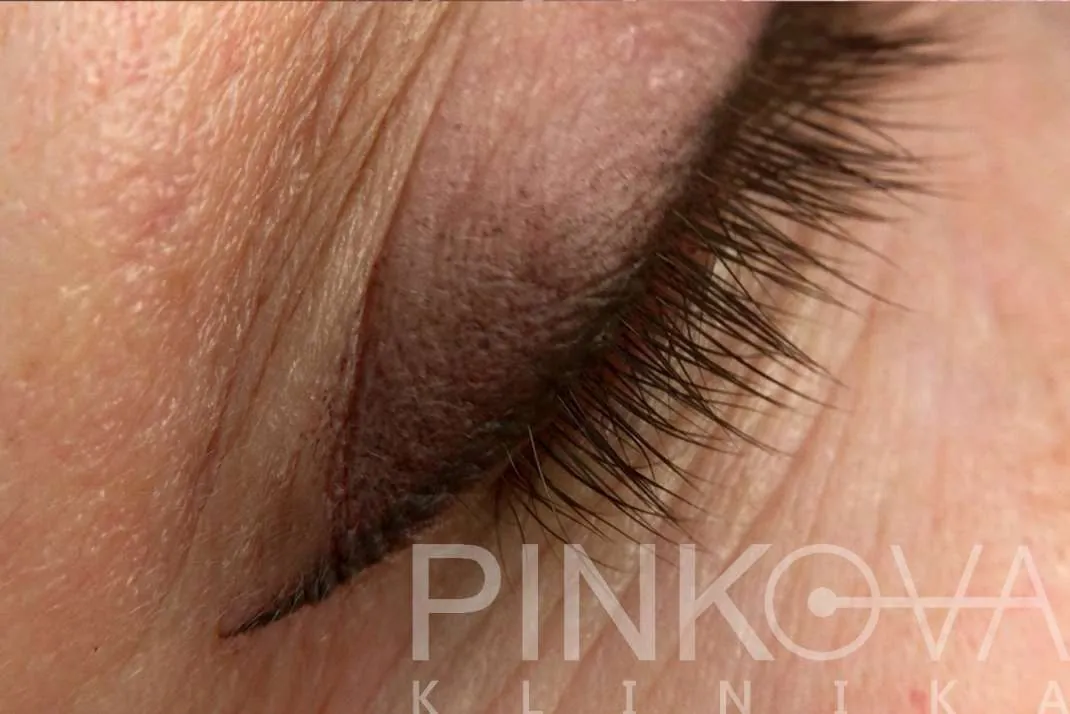
Please note. This is public information from specialist publications, not medical advice. If pain, blurred vision or discharge appears after a procedure near the eye, see a doctor without delay.
What the procedure looks like
An optometry journal describes the typical course: eyelid tattoos are removed by laser with settings chosen by pigment colour, skin type, amount and depth of pigment; local anaesthesia, a lubricating gel or ointment and metal eye shields are used, and the shields are removed after the laser [1]. Shields vary in diameter: some cover all the visible sclera, others only the cornea [1].
Where the risk lies
- Resurfacing-type lasers mainly threaten the cornea and ocular surface rather than deeper tissue, so protective lenses are required for work around the eye [2].
- Thinner shields at higher energy or longer wavelength can cause thermal corneal injury; one report describes a 1,064 nm laser used with a corneoscleral shield that caused heat injury to the cornea [1][2].
- Protection “from the eye side” is not enough: different devices need different shields (metal for lasers, plastic for radiofrequency), and standard shields do not protect against focused ultrasound [2].
- Even careful work does not rule out accidents – the physician stresses protection even when the patient or staff might move unexpectedly [2].
A clinical case on record
Four days after bilateral eyelid-tattoo removal, a 40-year-old woman developed eye pain, blurred vision and discharge. Corneal epithelial defects in both eyes and corneal oedema were found, and visual acuity was reduced. The suspected causes were shield movement or heat injury. The epithelial defects healed within a week and vision recovered [1].
Why qualification matters
A review of complications of ocular and periocular tattoos stresses that such procedures should be done only by qualified professionals who understand ocular anatomy, and that the most serious risk is visual impairment from improper technique or pigment placement [3]. The same applies to removal: ask which shields the specialist uses, how they are disinfected and how they are placed.
Sources
The statements in this article are backed by these sources (links open in a new window).
- Bozung A. Tattoo boo-boo (eyelid tattoo removal complication case). Review of Optometry, 15 January 2025Review of Optometry (trade journal for optometrists) · Unvetted source · 2026-11-06
- Preventable eye injuries (interview with B. S. Biesman, MD). Dermatology Times, 1 September 2017Dermatology Times (trade publication) · Unvetted source · 2026-11-06
- Lee KWA et al. Ocular and periocular tattoo adverse effects: a review. Diagnostics (Basel) 2024Diagnostics (Europe PMC abstract) · Study · 2026-11-06
This information is for general reading and does not replace a consultation with a doctor or specialist.