
How a carbon peel works
A carbon peel is not a chemical peel but a laser procedure with a carbon mask. Scientific data are still limited.
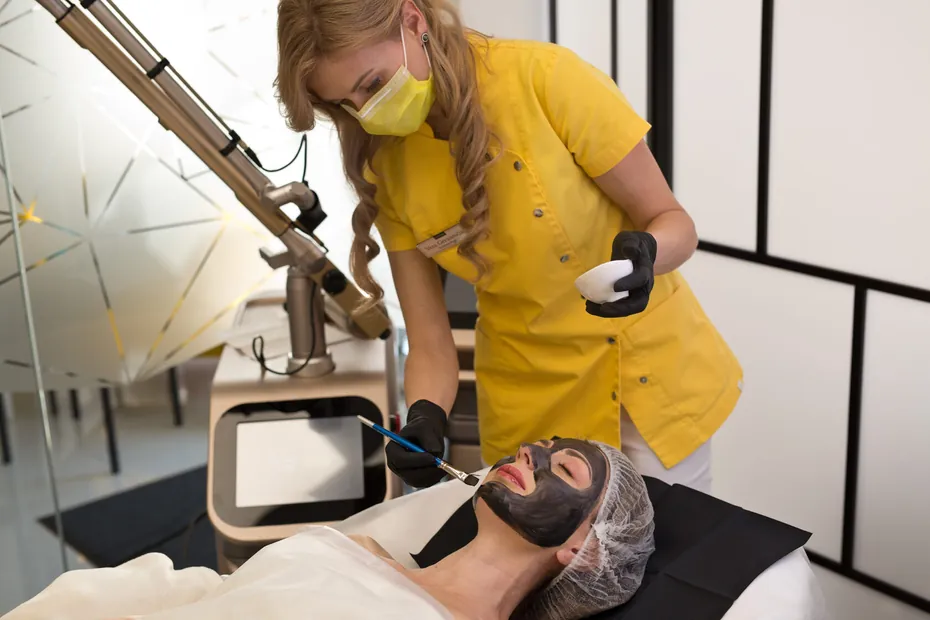
How the procedure is described
A study describes the technique: a carbon mask is applied to the face for about ten minutes, followed by irradiation with a Q-switched 1064 nm laser. Small carbon particles are thought to bind corneocytes and sebum within hair follicles; the laser removes the carbon together with these particles and the heat generated reduces sebum production and inhibits Cutibacterium acnes replication [1]. This is a hypothesis about the mechanism.
What studies show
- A 2022 retrospective study in a small group reports better skin texture, smaller pores and fewer acne lesions without serious problems; the authors acknowledge the small sample and retrospective design [1].
- In a 2011 study of enlarged pores in 25 women, a carbon lotion was applied to one half of the face: 75% showed improvement on that side versus 67% on the control side [2].
- In a 2010 comparison in 20 women, a carbon-assisted combination with a long-pulse laser did not differ significantly from the long-pulse laser alone: pore counts fell by 35.5% and 33%, and the carbon side had more adverse effects [3].
Where the sources disagree
A distributor of Lutronic lasers advertises the carbon peel (“Hollywood Peel”) as giving an instant glow and helping with fine lines, acne scars, redness, freckles and melasma, describing it as painless with minimal downtime; the page cites no studies [4]. A 2020 case report (one 42-year-old woman, three monthly sessions, judged from photographs) reports smaller pores and only mild redness, but its authors themselves say that little scientific literature exists, that studies are small and that treatment protocols still need to be established [5]. The same text says in one place that the peeling effect is proven and in another presents the mechanisms as hypotheses [5]. We found no controlled studies supporting the broader advertising claims.
We present both views so that you can weigh them; neither source replaces a specialist’s assessment.
An interesting fact: combining it with botulinum toxin – a pilot study
In a prospective pilot study, 20 patients had three sessions three months apart: carbon suspension and a Q-switched Nd:YAG laser were combined with diluted botulinum toxin delivered by microneedling. Scores for skin texture, wrinkles, enlarged pores and acne were statistically significantly better after treatment; the authors conclude that the combination may help with seborrhea, uneven skin and enlarged pores. It is a small study without a control group (level of evidence IV), so its results should not be taken as proof [6].
So do not expect miracles: there are no large high-quality trials, and the benefit of carbon over the laser without it is not clear.
Sources
The statements in this article are backed by these sources (links open in a new window).
- Conforti C et al. Carbon peeling laser treatment to improve skin texture, pores and acne lesions: a retrospective study. Dermatol Ther (Heidelb) 2022Dermatology and Therapy (Europe PMC abstract) · Study · 2026-11-06
- Chung H et al. Enlarged pores treated with a combination of Q-switched and micropulsed 1064 nm Nd:YAG laser with and without topical carbon suspension. 2011Journal of Cosmetic and Laser Therapy (Europe PMC abstract) · Study · 2026-11-06
- Wattanakrai P et al. Split-face comparison of long-pulse-duration Nd:YAG 1,064-nm laser alone and combination with carbon photoenhancer lotion for enlarged pores. Dermatol Surg 2010Dermatologic Surgery (Europe PMC abstract) · Study · 2026-11-06
- Hollywood Peel (carbon peel) - device and treatment pageBioSkin Italia, distributor of Lutronic lasers · Unvetted source · 2026-11-06
- Guida S et al. Carbon peel laser technique to improve skin quality: back to science! Dermatol Pract Concept 2020Dermatology Practical & Conceptual (PubMed Central) · Study · 2026-11-06
- Turco P, Conforti C, D’Andrea F, La Padula S. Carbon-assisted Q-switched Nd:YAG laser and microneedling delivery of botulinum toxin: a prospective pilot study. Plast Reconstr Surg 2024Plastic and Reconstructive Surgery (Europe PMC abstract) · Study · 2026-11-06
This information is for general reading and does not replace a consultation with a doctor or specialist.