
How lasers remove tattoos and permanent makeup
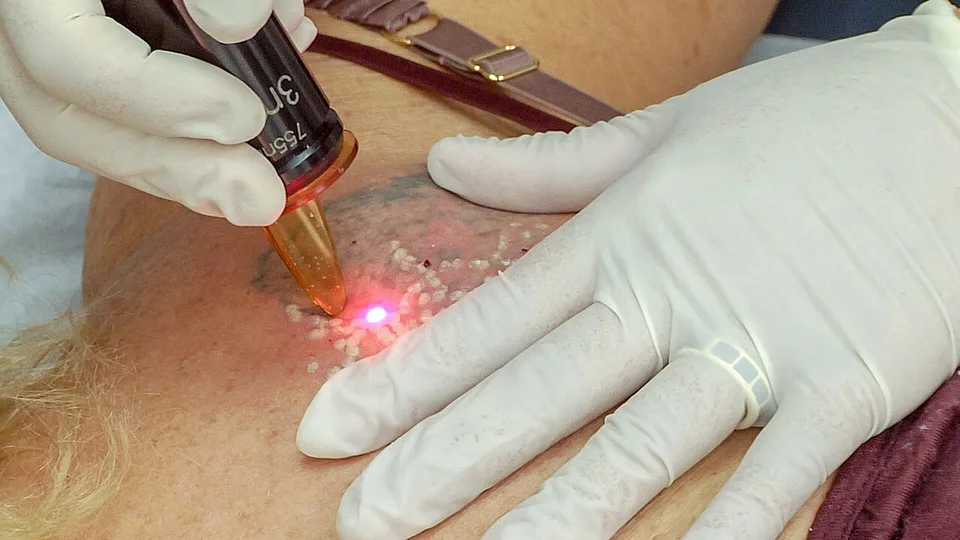
The laser does not “burn out” the ink — it breaks it into particles that the body gradually clears.
The principle
Mayo Clinic describes Q-switched lasers as the usual choice: they deliver energy in a single short, powerful pulse; the heat breaks up the ink and the body clears it [1]. The Aesthetic Society likewise states that short pulses are absorbed by the ink, broken into smaller particles and cleared by the immune system over time; skin reaction is tested first and eye shields are worn [2].
Which lasers are used
A review names the most common: 532 nm and 1064 nm Nd:YAG, Q-switched ruby (694 nm) and alexandrite (755 nm), with picosecond lasers gaining favour [3]. Different colours respond better to different wavelengths, so devices are sometimes combined [1][2].
Picosecond technology
The German manufacturer Asclepion describes its picosecond system (532 and 1064 nm, pulses under 300 ps) as breaking ink into smaller particles than nanosecond lasers, which the manufacturer says allows gentler treatment and faster clearance of pigment [4]. These are the manufacturer’s own statements.
What the clinical studies show
In a systematic review of 46 studies, Nd:YAG lasers mostly cleared black and blue pigments well, but several sessions were needed. Picosecond systems may reach a similar result in fewer sessions or at lower fluence, yet the review did not demonstrate a consistent advantage over the nanosecond Q-switched laser [5].
Why there is no single answer to “how many sessions”
In a retrospective analysis of 545 patients treated with a picosecond laser, a scale for predicting the number of sessions was proposed using six parameters: tattoo type, pigment density, body location, ink colour, scarring and layering (one tattoo over another). The older Kirby–Desai scale, built for nanosecond lasers, overestimates the number of sessions for modern picosecond devices [6].
Why the specialist’s experience matters
A review of laser complications reminds us that risk arises from an unsuitable device, settings, insufficient patient assessment or limited operator experience [7].
The specialist chooses the laser and settings by ink colour, depth and skin type.
Sources
The statements in this article are backed by these sources (links open in a new window).
- Tattoo removalMayo Clinic · Guideline · 2026-11-06
- Tattoo removal: detailed procedure informationThe Aesthetic Society · Guideline · 2026-11-06
- Hernandez L et al. Laser tattoo removal: laser principles and an updated guide for clinicians. Lasers Med Sci 2022Lasers in Medical Science (Europe PMC abstract) · Study · 2026-11-06
- PicoStar: picosecond laser systemAsclepion Laser Technologies (Germany) · Manufacturer · 2026-11-06
- Wong J et al. Efficacy of Nd:YAG lasers for tattoo removal: systematic review of clinical outcomes, clearance rates, and treatment parameters. J Cosmet Dermatol 2026Journal of Cosmetic Dermatology (Europe PMC full text) · Study · 2026-11-06
- Pedrelli V et al. Prediction of tattoo removal sessions with picosecond lasers: development and validation of a novel clinical scale. J Cosmet Dermatol 2026Journal of Cosmetic Dermatology (Europe PMC full text) · Study · 2026-11-06
- Nguyen L et al. Complications of laser and energy-based procedures in dermatology: classification, management, and prevention. J Dtsch Dermatol Ges 2026Journal der Deutschen Dermatologischen Gesellschaft (Europe PMC abstract) · Study · 2026-11-06
This information is for general reading and does not replace a consultation with a doctor or specialist.