
How laser hair removal works and why it takes a course
Laser hair removal rests on one idea: light is absorbed by the pigment in the hair and turns into heat that damages the follicle. The same idea explains why results come in stages.
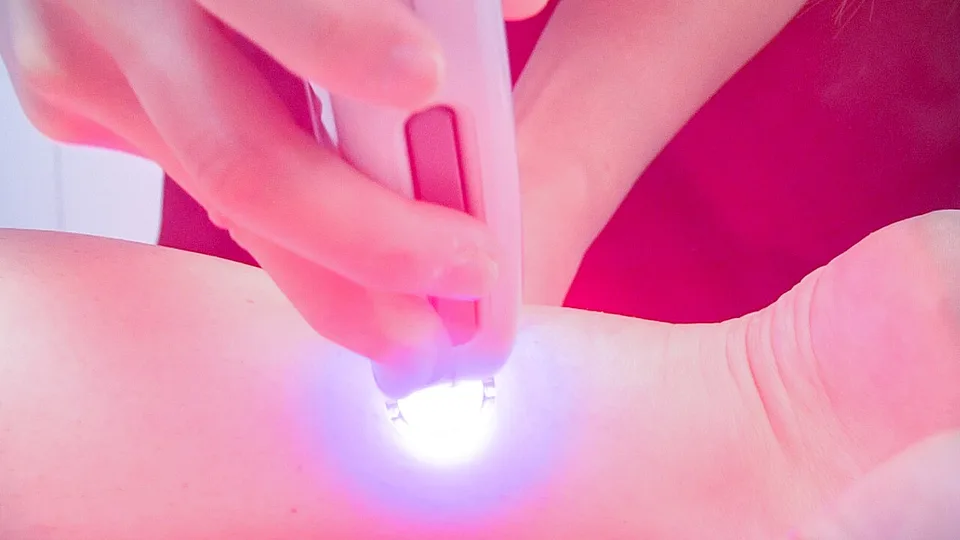
The principle: light and pigment
In 1983 Anderson and Parrish described selective photothermolysis: light of a suitable wavelength is absorbed mainly by a chosen target and heats it, while the surrounding tissue is affected less [1].
In hair removal the target is the pigment (melanin) in the hair. The heat is meant to damage the follicle, including the stem cells of the bulge region, which are linked to hair regrowth [2].
Types of devices
Several light sources are used: ruby (694 nm), alexandrite (755 nm), diode (800–810 nm) and Nd:YAG (1064 nm) lasers, and intense pulsed light (IPL) [2]. A review of clinical studies found alexandrite, diode, Nd:YAG and IPL all effective, with Nd:YAG the best choice for pigmented skin [3].
Devices also differ in skin cooling and pulse settings. For example, the German manufacturer Asclepion describes diode systems combining 810 and 940 nm, and a “Mediterranean Protocol” combining 808 and 1060 nm, with contact cooling of the skin [4].
Why one session is not enough
The American Academy of Dermatology (AAD) says most people need 2 to 6 treatments, 4 to 6 weeks apart, and that the first session typically reduces hair by about 10 to 25% [5]. Mayo Clinic mentions 4 to 8 treatments [6].
Published studies give wider ranges: one review reports 10–40% reduction after a single session, 30–70% after three and up to 90% with repeated treatment, with the effect lasting up to 12 months in the groups studied [7].
Hair that grows back is usually finer and lighter [5]. Mayo Clinic stresses that a permanent result is not guaranteed [6].
What recent clinical data show
In a study where 60 patients had three sessions with Nd:YAG, diode and alexandrite lasers used in rotation, hair reduction at six months averaged 75.07%, the remaining hairs were thinner and vellus hairs increased. Pain averaged 2 out of 4, and redness and perifollicular swelling resolved within days; there were no long-term adverse effects [8].
One wavelength or two?
In a small study (20 women, armpits, skin types II–III), a single-wavelength 755 nm laser reduced hair by 92% against 69% for a dual-wavelength (755 and 1064 nm) laser, and the dual one caused slightly more adverse effects [9]. This is a single small sample, so the device and wavelength are always chosen by the specialist to suit your skin and hair.
The numbers vary with hair colour, skin type, body area and device. The number of sessions for you is set by the specialist after an assessment.
Sources
The statements in this article are backed by these sources (links open in a new window).
- Anderson RR, Parrish JA. Selective photothermolysis. Science 1983Science (Europe PMC abstract) · Study · 2026-11-06
- Laser hair removal. Vano-Galvan S, Jaen P. Can Fam Physician 2009;55(1):50-52Canadian Family Physician (PMC) · Study · 2026-11-06
- Gan SD, Graber EM. Laser hair removal: a review. Dermatol Surg 2013Dermatologic Surgery (Europe PMC abstract) · Study · 2026-11-06
- MeDioStar: diode laser systemAsclepion Laser Technologies (Germany) · Manufacturer · 2026-11-06
- Laser hair removal: FAQsAmerican Academy of Dermatology · Guideline · 2026-11-06
- Laser hair removalMayo Clinic · Guideline · 2026-11-06
- Lepselter J, Elman M. Biological and clinical aspects in laser hair removal. J Dermatolog Treat 2004Journal of Dermatological Treatment (Europe PMC abstract) · Study · 2026-11-06
- Bacchini S et al. Medical laser hair removal: a new rotational approach. Lasers Med Sci 2025Lasers in Medical Science (Europe PMC abstract) · Study · 2026-11-06
- Shurrab K, Alnajjar RM. Effectiveness of single-wavelength 755 nm laser compared to dual-wavelength 755 nm and 1064 nm laser in hair removal: a split-body design with blinding. Health Sci Rep 2026Health Science Reports (Europe PMC abstract) · Study · 2026-11-06
This information is for general reading and does not replace a consultation with a doctor or specialist.